LLM-Jacking: How Leaked AWS Credentials Are Triggering $40K – $80K AI Billing Attacks
It starts quietly.No alerts. No warnings. No obvious breach.Then suddenly—an email from AWS:“Your current bill has exceeded $35,000.”For many developers and startups, this isn’t a...
It starts quietly.
No alerts. No warnings. No obvious breach.
Then suddenly—an email from AWS:
“Your current bill has exceeded $35,000.”
For many developers and startups, this isn’t a hypothetical scenario anymore. It’s a growing pattern discussed across forums: AWS accounts being compromised and abused to generate massive costs—often through AI services like Amazon Bedrock.
What used to be crypto mining attacks has evolved into something faster, easier, and far more expensive.
Welcome to the era of LLM-jacking.
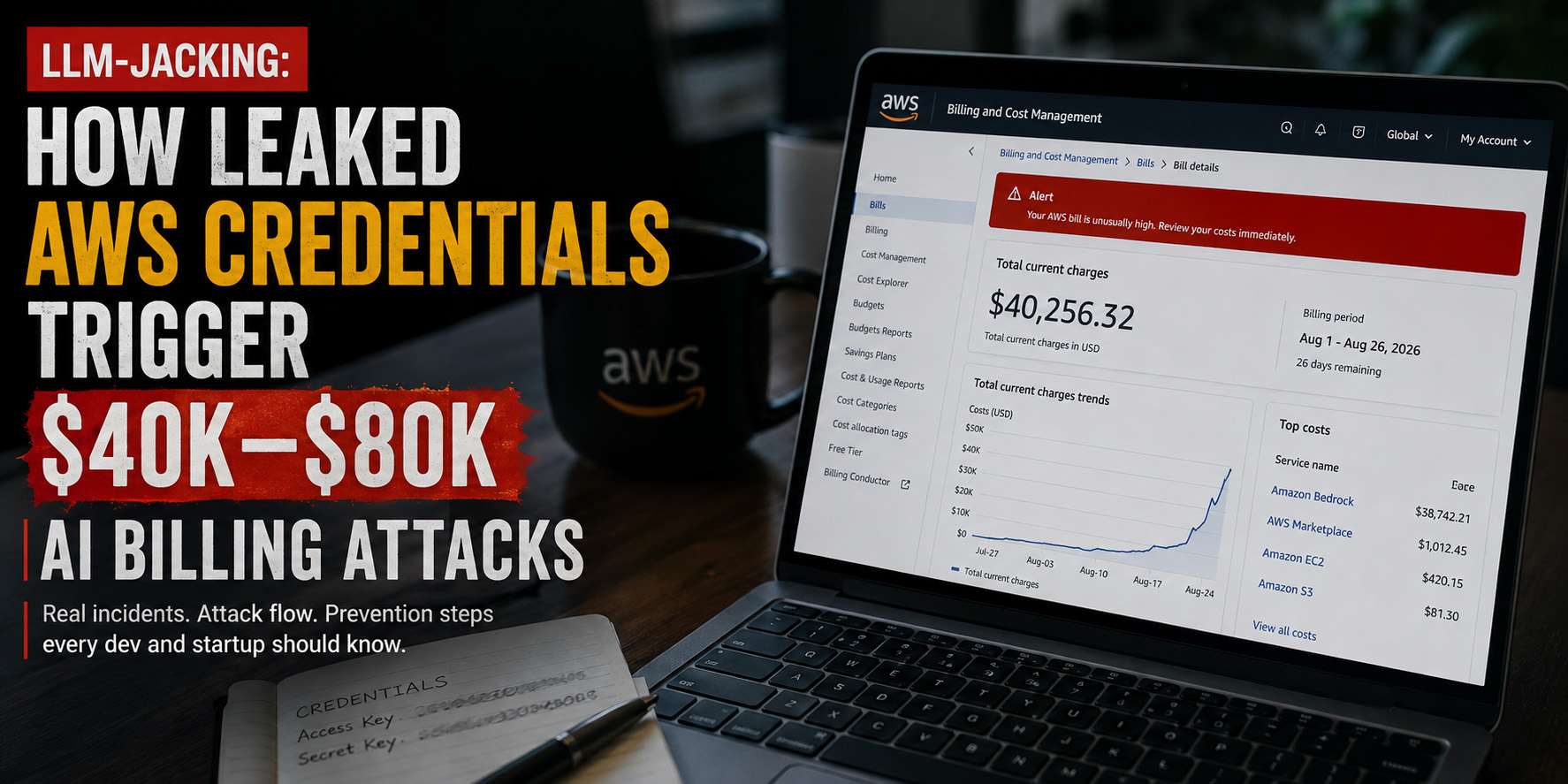
The Incident Pattern: From Normal Usage to Massive Bills
Across multiple real-world cases, the pattern is consistent:
A developer unknowingly exposes AWS credentials
Attackers discover the keys within minutes or days
Automated scripts begin abusing cloud services
Thousands—or even tens of thousands—of dollars are charged in hours
In one case, a user reported $40,000 in charges within just 3 hours.
In another, $14,000 was spent purely on AI model usage.
Security researchers have observed $80,000+ generated in under 9 hours.
This isn’t rare—it’s becoming a repeatable attack pattern.
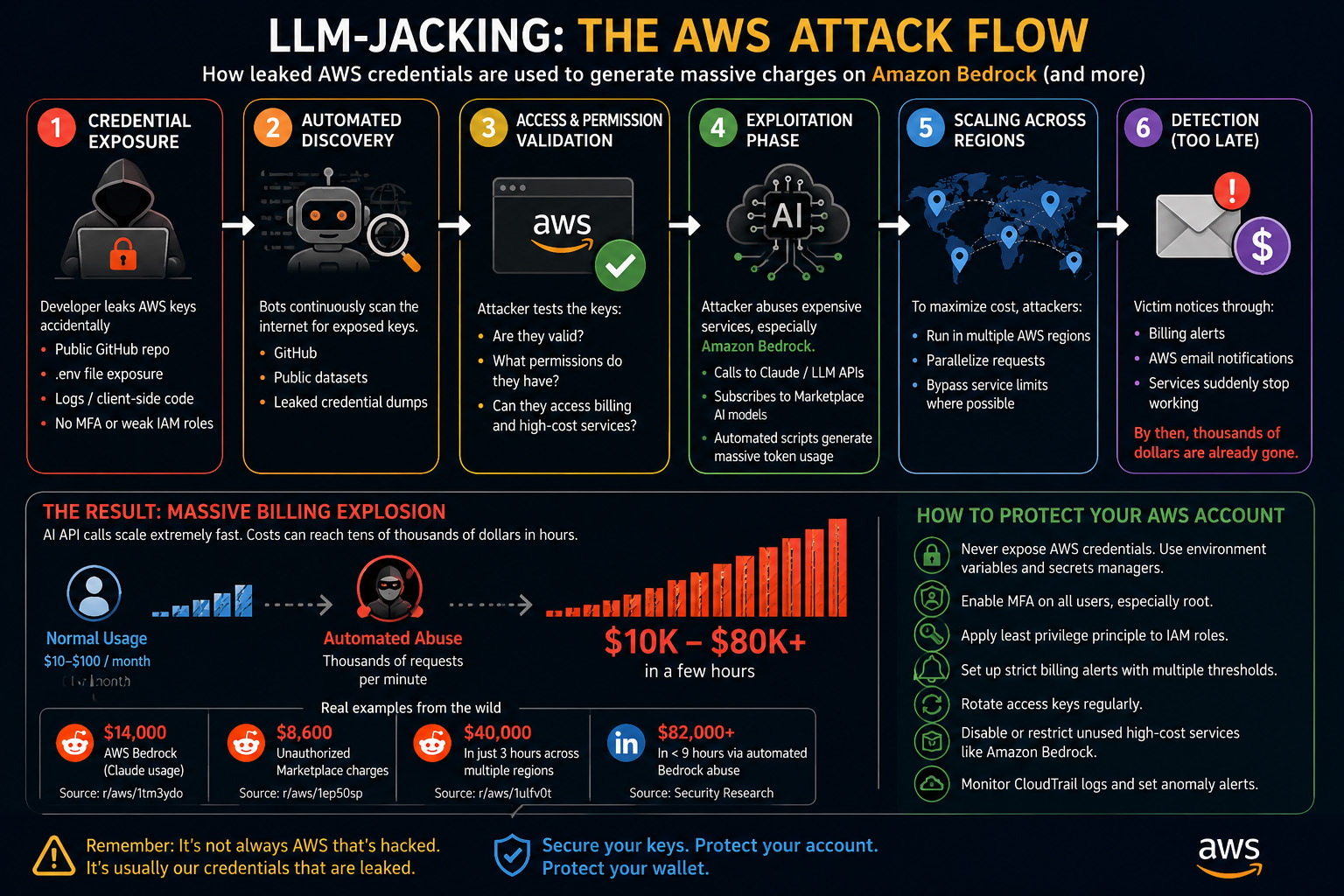
Visual Breakdown: The AWS LLM-Jacking Attack Flow
A Realistic Timeline of an AWS Account Compromise
1. Credential Exposure (Day 0)
The attack almost always begins with a simple mistake:
API keys committed to a public GitHub repo
.envfiles accidentally exposedCredentials leaked in logs or frontend code
No MFA or overly permissive IAM roles
These keys often remain active longer than expected.
2. Automated Discovery (Minutes to Hours)
Attackers don’t manually search for keys.
They deploy bots that continuously scan:
GitHub repositories
Public datasets
Credential dumps
Once found, keys are validated instantly.
3. Access Validation (Seconds)
Attackers quickly check:
If the key is still valid
What permissions it has
Whether high-cost services (like Bedrock) are accessible
If everything checks out, exploitation begins immediately.
4. Exploitation Phase (Minutes to Hours)
This is where the evolution happens.
Old Method: Crypto Mining
Launch EC2 instances
Run mining workloads
Gradually increase cost
New Method: LLM-Jacking
Call AI APIs (e.g., Bedrock models like Claude)
Generate massive token usage
Scale instantly via automation
No infrastructure setup needed—just API calls.
5. Scaling Across Regions
To maximize billing impact, attackers:
Execute requests across multiple AWS regions
Run parallel workloads
Push usage limits aggressively
This is why costs skyrocket so quickly.
6. Detection (Too Late)
Most victims discover the issue when:
Billing alerts trigger
AWS sends warnings
Services suddenly stop working
By this point, the damage is already significant.
7. Damage Control
Typical response:
Revoke compromised credentials
Enable MFA
Lock down IAM roles
Contact AWS support
Refunds may happen—but they are not guaranteed.
Why Amazon Bedrock Is a Prime Target
AI services introduced a new attack surface.
High Cost per Request
LLMs process tokens, and costs scale extremely fast.
No Infrastructure Required
Attackers don’t need to spin up servers—just send API calls.
Instant Monetization
Subscriptions and API usage begin billing immediately.
Harder to Detect
Traffic can look like normal API usage at first.
Technical Breakdown of the Attack Flow
Leaked AWS Key
      ↓
Automated Bot Detection
      ↓
Permission Validation
      ↓
Bedrock API Abuse / Marketplace Subscription
      ↓
Multi-Region Scaling
      ↓
Massive Billing Explosion
This entire process can happen in under an hour.
A Shift in Cloud Threats
This isn’t just a security issue—it’s a shift in attack strategy.
Before:
Infrastructure abuse (EC2, storage)
Slower cost accumulation
Now:
AI service abuse (LLMs, APIs)
Rapid financial impact
The barrier for attackers is lower, but the damage is higher.
Key Takeaways for Developers
Never expose AWS credentials
Enable MFA on all accounts
Apply least privilege IAM policies
Set multiple billing alerts
Rotate keys regularly
Disable unused high-cost services
Monitor logs (CloudTrail, usage spikes)
Conclusion
What we’re seeing isn’t just developer error—it’s the rise of a new class of cloud attack.
LLM-jacking is fast, scalable, and expensive.
And as AI services become more integrated into cloud platforms, this threat will only grow.
Your AWS credentials are no longer just access keys—they are financial liabilities.
Protect them accordingly.
Related reading

Filipino Developers Divided Over Bryl Lim’s “Copycut Apps” Commentary
A recent discussion initiated by developer and AI engineer Bryl Lim has sparked a split reaction within the Filipino indie developer community, reigniting debates about originality, competition, and...
Platform Seeks to Boost Visibility of Filipino-Made Apps
A newly launched platform is aiming to strengthen the presence of Filipino-developed applications by providing a dedicated space for discovery, promotion, and community engagement.As the Philippine...